
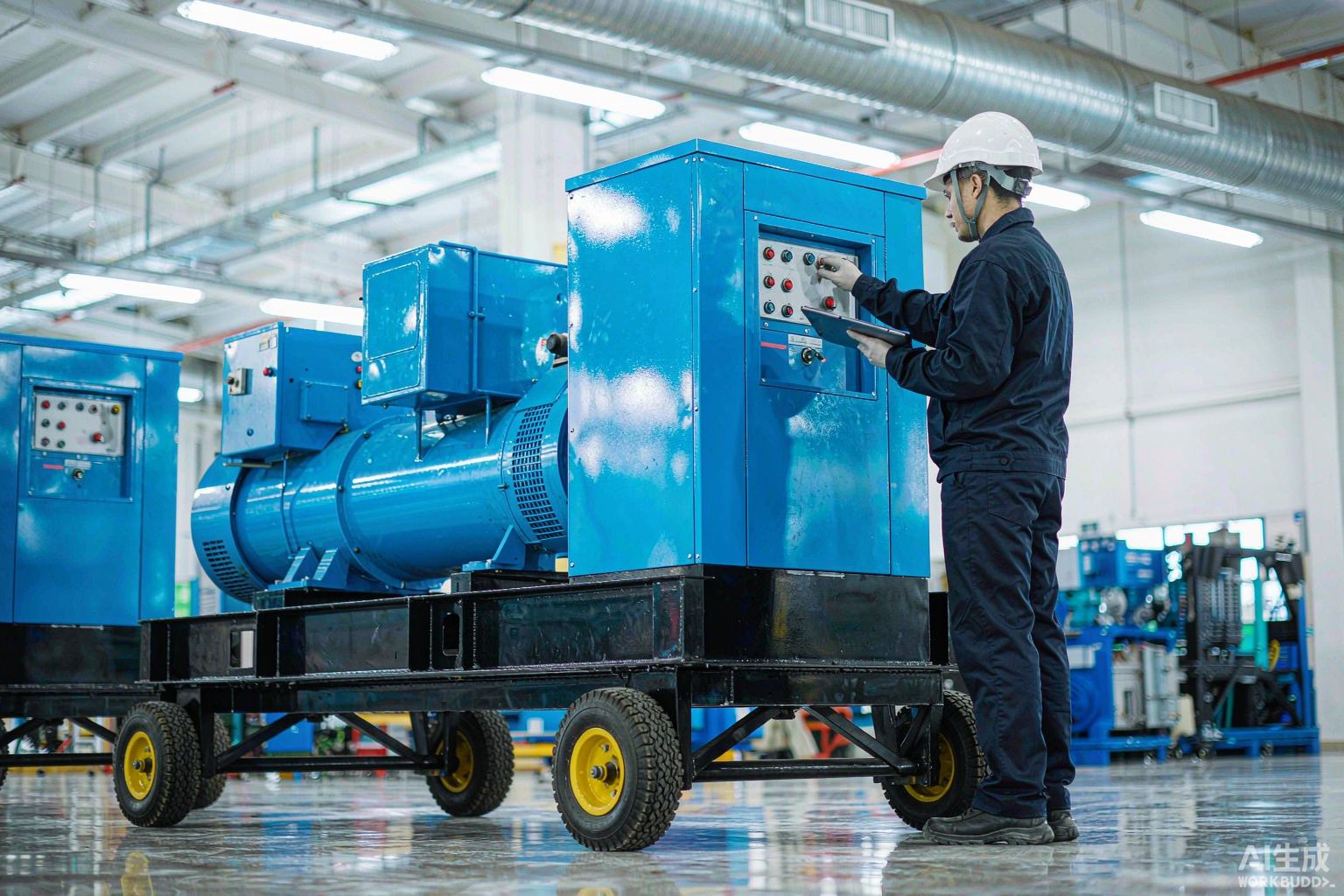
What a Four-Point Load Test Proves Before a Generator Ships
Starting a set and watching the voltage settle proves almost nothing. Here is what a 25 / 50 / 75 / 100 % load test actually measures, and which faults only appear under load.
The same engine can be sold at three different ratings. Picking the wrong one either wastes capital or shortens engine life — and the difference is measured in hours per year.
Two quotations for the same 800 kVA set can differ by 60 kW of declared output without either supplier being dishonest. The gap is the duty rating. It is the single most misunderstood line on a generator data sheet, and it decides how long the engine lasts.
Standby (ESP) is for mains failure. The set runs while the utility is down, at a variable load, for a limited number of hours per year. No overload is permitted. This is the rating for hospitals, offices and data centres that only generate when the grid fails.
Prime (PRP) is for continuous supply at a variable load. The set can run unlimited hours, and may carry a 10 % overload for one hour in every twelve. This is the rating for islanded sites, mining camps, rental fleets and anywhere the generator is the grid.
Continuous (COP) is for a steady load, non-varying, unlimited hours, with no overload allowance. It suits base-load industrial processes rather than buildings.
| Standby / ESP | Prime / PRP | Continuous / COP | |
|---|---|---|---|
| Typical hours per year | up to ~200 | unlimited | unlimited |
| Overload allowance | none | 10 % for 1 h in 12 | none |
| Load profile | variable, mainly partial | variable | steady |
| Typical application | backup to mains | islanded / rental | base-load process |
Buyers often compare a 900 kVA standby set against an 800 kVA prime set and conclude the first is better value. On paper it is bigger; in service it is a different machine. A standby-rated set run as a prime source is being operated outside its intended envelope, and the manufacturer's warranty usually says so. If a site will generate more than a few hundred hours a year, the prime rating is the honest comparison — even though the number is smaller.
For most enquiries the honest answer is not obvious until the duty is known, so Cunmi quotations list the standby and prime figures side by side for the same model, with the price difference. That way the buyer can see what the extra rating costs and decide with the whole picture rather than discovering the distinction after the purchase order.
Occasionally, yes — most engines tolerate an extended outage. The constraint is cumulative: the standby rating assumes a limited number of hours per year, and a week-long event consumes a large part of that allowance. If long outages are expected, specify prime from the start.
Sometimes. The same block may be sold at different ratings with different fuel settings, cooling packages or aftertreatment calibration. The model code usually carries the rating, which is why two sets that look identical can have different declared outputs.
Emission certification is tied to a duty cycle, and some markets certify only standby or only prime for a given engine. When both are available we state which rating the certificate covers.
Starting a set and watching the voltage settle proves almost nothing. Here is what a 25 / 50 / 75 / 100 % load test actually measures, and which faults only appear under load.

Buying the next size up feels safe. In practice it moves cost from the capital budget into fuel, maintenance and premature engine wear — and it rarely improves reliability.
Low-load running looks gentle on the machine. In reality it is one of the fastest ways to glaze bores, load a DPF with soot and double your maintenance bill.
Send the load schedule, site conditions and destination port. We answer technical questions directly, usually within one business day.